


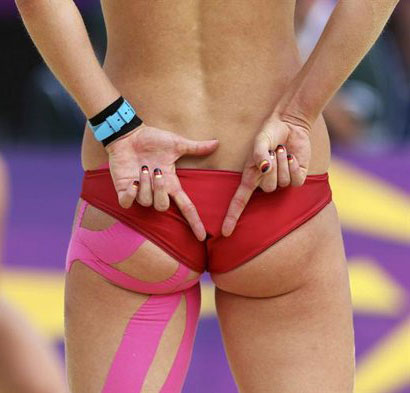
What is kinesiology taping and how does it work? The famous coloured plasters that relieve pain and traumas and help athletes improve their performance.
Lately we hear more and more talking about elastic taping or kinesiology tape, and we also see them on athletes in tv but also on common people, how do they work, what is their use and when can they be used.
Within our team we have certified experts in this particular application, but lets start from the beginning: Doctor Kenzo Kase (Japan), in 1973, studying kinesiology science, elaborated a 100% natural self-healing method for the body, very often victim of traumas, with the help of a non invasive and non pharmacological technique, claiming that it could help muscular function through external assistance, meaning through the use of an elastic plaster. This technique was spread out on occassion of the Seul Olympics held in 1988, when the Japanes athletes were introduced to the audience covered in colourful tape. Only at the end of the ’90s it became affirmed at international level, first in the U.S.A. than in Europe. In Italy it was spread out by the Australian David Blow in 1999 than by the physiotherapist of the Italian national roller skating team of that time Dr. Rosario Bellia. In the beginning it was used only by athletes and sports fanatics, nowadays it is used by a large percentage of the world’s population. Nowadays there is a massive use both in the athletic performance improvement market but also for improvement at postural level.
WHAT IS TAPING AND HOW DOES IT WORK?
It is a plaster that includes a layer of cotton with a millimetric thickness and a particular latex free adhesive. Through the application on the body some spaces are created in the tissues these stimulate the cellular metabolism giving our body natural self-healing capability. The application of this plaster allows our body whilst in movement to facilitate lymphatic drainage, hence facilitating blood vascularization, this way reducing pain, moreover it can improve athletic performance obviously according to the type of application. The certified operators/experts obviously know where and how to apply these plasters, it is therefore not recommended to try to apply it on your own otherwise you may risk not seeing results or even worse harming yourselves.
Taping can therefore, according to direction, position or tension in with which it is applied inhibit contracted and exhausted muscle or on the contrary stimulate a hypotonic one. Its application, done in the correct way, helps resolve various problems like for example paravertebral lumbar contractures, tendinitis, cervical arthritis but also headaches, carpal tunnel syndrome and backache. Professor Bellia (physiotherapist for the Italian national roller skating team and kinesiology taping lecturer at the Valencia State University), explains that the taping technique bases itself on the self-healing ability the human body has, as long as its stimulated by the activation of the “neuro-muscular” and “neuro-sensorial” system, according to the neuroscience latest news. However on the other hand the incorrect application of kinesiology tape although not being particularly harmful will not give any benefit whatsoever and can delay the use of an indispensable medical treatment for a determined pathology.
There are 2 types of approach for taping application:
- Decompressive
- Compressive or stability
The decompressive modality is required in the recovery or rehabilitation stage and is used in the sports field but also and especially on traumas even not of sports character, in other words this is the modality that we will use to cure cervical pains or low back pain as it has specific characteristics:
– It removes the congestion of the flow of te body fluids, improves blood circulation and lymphatic drainage; it reduces excessive heat and excessive chemical substances present in tissue; reduces inflammation; it also reduces the abnormal sensitivity and the pain in skin and muscles;
– It activates the endogenous analgesic systems to stimulate the spinal inhibitor system and the descending inhibitory system;
– It corrects joint problems, reduces wrong alignments caused by spasms and shortened muscles; it normalizes mucle tone and joint end abnormalities.
The compressive modality is mostly used in the sports stage as:
–It supports the muscle and improves contraction in weaker ones; reduces muscle fatigue; reduces excessive muscle extension and contraction; reduces cramps and possible muscle wounding; increases ROM (muscle range of motion);
-corrects joint and tendon problems to improve inaccurate alignments caused by spasms and shortened muscles; supports wounded and weak tendons;
-It supports muscle, ligament, joint or bones post trauma during the sports activity.
Currently apart being very much in fashion it turns out to be very effective, witnessing that our body owns an incredible self-healing power.
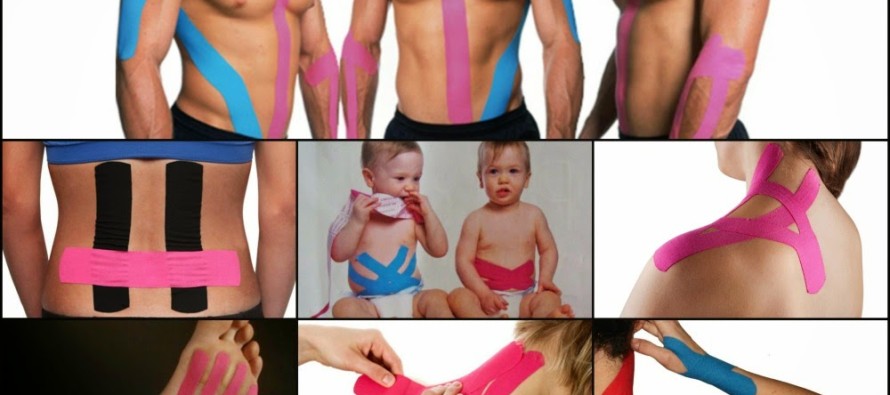
In this image on the left we can see some types of applications used for either sports practicing or relieving pain and trauma, this is just to give you an idea what it is all about, the colours are different but all have the same use and in Italy are used indifferently, however in the theory of their creator the colours were used to influence positively the mood according to ancient oriental disciplines, therefore for example blue was used to reduce inflammation.
Kinesiology tape is suitable for everyone and every age, just make sure that who applies it is a certified professional, hence do not hesitate to contact us if you have any questions, curiosity, whether you would like us to apply it for you or simply to check if the person applying it to you is a certified professional or not.


Leave A Comment