


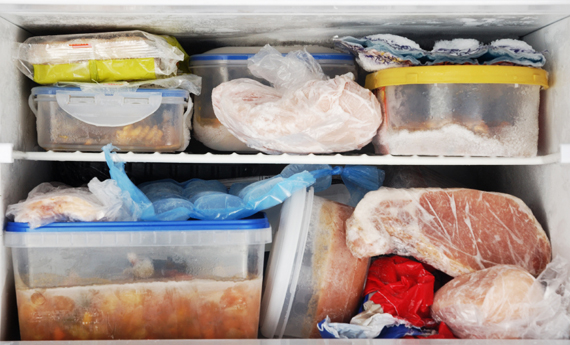
How to freeze food properly at home in order to preserve them!
What foods can we freeze at home and how do they maintain their taste.
Lets start by understanding that we cannot freeze everything at home, lets see what can be frozen and how to do it properly.
First of all we cannot deep freeze because frozen foods have an internal temperature of minus 18 degrees, which is obtained thanks to very rapid cooling that takes place in special machines and usually directly at the source, for example the many companies that sell frozen fish, start the freezing process directly on the ships.
In order to be able to deep freeze at home we should have a domestic chiller but usually these are very expensive.
In the normal freezer at home we can just FREEZE, which means that it takes some time (sometimes almost 24 hours) to reach a temperature of -12 or -15 degrees. This slow freezing however can damage some nutrients of the food and therefore it is necessary to know some procedures and some tricks in order to freeze properly.
TWEAKS TO FREEZE PROPERLY FOOD AT HOME
- Do not fill the freezer to the brim. A freezer full of food is a warmer freezer that accordingly employs more time to cool. The best thing to do is to put away the things to freeze as close as possible to the walls and leave a little space between one and the other.
- Do not freeze foods that are too thick. For freezing use thin slices. In the case of meat or fish the thickness must not exceed 2 and a half centimetres.
- Attention to the stars. Before buying a freezer check how many stars or snowflakes it has (at least 3 or 4) these indicate whether it can reach -18 degrees.
- The foods must be dry. If foods are wet, once in the Freezer further ice will form inside the bag or container, hence ruining the structure of the food.
HOW IS FOOD FROZEN
- Fruit may be frozen but divided between large and small. The large fruit should be peeled and chopped, while the small fruits can be frozen whole (for example berries).
- For some types of vegetables it is better to avoid freezing from raw: asparagus, beets, carrots, courgettes, spinach and peas must first be passed in boiling water. Then cooled and dried.
- With regards to meat it should first have the fat removed.
- The fish must be cleaned before then rinsed and dried. Put the slices first in food paper or cling film than in a freezer bag.
- Even bread can be frozen but it must be wrapped in aluminum foil.
- Fresh pasta must be put in the freezer bags.
- The dough for bread and pizza should be frozen wrapped in greaseproof paper and then put into a freezer bag: it will rise once thawed.
HOW TO FREEZE FOOD AT HOME
Usually when we have food left over and do not know what to do with it, so we freeze it. We can almost freeze everything we cook, but attention because they must not be made with ingredients that were previously frozen (example: lasagna must be made with fresh meat) and must be frozen at room temperature.
WHICH FOODS CANNOT BE FROZEN
There are also some foods that we cannot freeze because they change their taste or because they lose completely all their content of vitamins and nutrients or because they change their structure:
– Garlic, onion, sage, cloves and fried food, because they change flavour.
– Hard Egg White and mayonnaise because they lose consistency.
– Lettuce, tomatoes, celery, cucumbers and other vegetables use for salad because they languish.
– Uncooked apples and grapes are ruined.
– Raw Bananas, avocado, peaches and pears blacken.
DO FROZEN FOODS EXPIRE?
Even the food that we freeze at home has an expiry date or better a maximum time within which it must be consumed. In general the more fat they are the less they last. For example fish can be kept for a month, Turkey about two, ready meals such as a lasagna three, bread three months and fruit a maximum 12. However if the freezer has four stars in general it retains everything for 12 months.
HOW TO DEFROST FOOD
What we often do not know is that the fundamental part is precisely the defrosting because not only it may cause the loss of all the nutrients but could also proliferate bacteria. The best thing you can do is let the food thaw in the fridge to avoid bacteria or directly in a microwave oven with the defrost mode . You can also thaw directly with the cooking. Also the dough for bread or pizza should be left to settle overnight in the refrigerator and then left at room temperature for complete leavening.
Take a look at our tried and tested method: Anti-Diet


Leave A Comment