


Are you sure to know everything about abdominals and how to train them?
Discover all the fake myths and fake theories on abdominals and how to obtain a toned abdomen/belly.
How often at the gym we hear and talk about lower or upper abdominals or about the famous 6 pack, but actually we know very little or they know very little even many instructors, hence lets make things clear and understand well what the abdominal muscles really are, how they are formed and hence which is the best way to work them out obtaining good results. Lets begin by saying that the abdominal muscles do not only have important motor skills but also play an important role in keeping the correct posture of our spinal column/backbone, infact they help our back avoid itself from arching too much with the possibility of compressing the spinal nerves on the long run. Such a situation will lead to painful inflammations such as sciatica or other problems linked to an incorrect posture. Furthermore strong abdominal muscles mean more resistance in our organism, infact when one suffers from cervical pain exercises to strengthen these muscles are infact suggested. The abdominal muscle or better the rectus abdominis is a single muscle (therefore no upper or lower abdominals exist on the contrary to what we are usually told), it begins from the sternum and places itself on our pubis. When it is well developed and visibly toned we can see the 6 epigastrics, the famous 6 pack or the typical tortoise shape abdominal expression.
Now lets learn how to train this complex muscle in a correct way and why most of us make a big mistake when we do a classic floor crucnh. The rectum is a containment muscle, working in isometry, flexing the torso towards the pelvis and viceversa. This is why it is very important to exclude as much as possible the legs from working. During isotonic movement the best benefits are obtained by concentrating on the negative stage of contraction, that is the return that will be very slow. Weights must be used if visible development is requested.
Since the rectum is a muscle that has a movement angle of about 30°, it is also true that the maximum muscle tension is reached by extending the torso by approximately 15°, before flexing it. And it is by considering this characteristic that we can understand how a crunch (the classic movement from the ground) done on the ground does not allow the entire muscle to work out. Moreover in the classic crunch, our hands are placed on our neck to relieve the muscle tension that worsen the neck muscles and cervical, but apparantely this does not help and as some experts affirm holding our head with our hands placed behind it allows a contraction by reflex of the shoulders stabilizer muscles and therefore it is better to leave our arms laid along our sides limiting them to slip along our legs during the exercise.
The abdominals are made out fast contraction fibres and this type of fibres respond well to heavy weight training, a little repetitions, practically repeating the say exercise more than 15 times in a row will practically result ineffective, as repetition we mean the number of times a series of for example 8 movements is repeated therefore:
- BEGINNERS: about 15 reps for 2/3 series. (in this case for example we repeat 15 times a series made out of 8 movements + another series of 8 movements different from the first, LIGHT MOVEMENTS WITH FAST MOVEMENT WHEN DOING THE EXERCISE AND SLOW WHEN RETURNING IN POSITION)
- EXPERTS: 8/12 reps for at least 3 series.
- ATHLETES: 4 reps per series WITH A HEAVY WEIGHT LOAD
The abdominal exercises used in Styleoga® yoga are excellent since they involve also deeper muscle fibres and also improve physical balance.
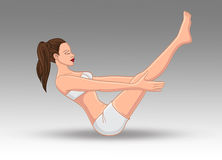
This exercise as shown in the figure on the left helps maintain balance and improve it, staying in this position for approximately 40 seconds makes sure that all the abdominal fibres are contracted in such a way to work deeper giving us noteable results. It is a very tiring and difficult position but it excludes any type of injury or pain and is ideal for any age.

Another very useful position is this upside down position as figured here on the right, were on the contrary to what one may think there is no strain on the head or neck, the greatest effort is felt on the forearms and especially on the abdominal muscles that must literally support all the weight of the body. Through the contraction of the abdominal muscles we manage to stay in this position and the work is so intensive that it allows the development of the epigastrics (6 pack).
If you want to deepen and start with the basics of yoga take a look at our ebook yoga for everyone


Leave A Comment