


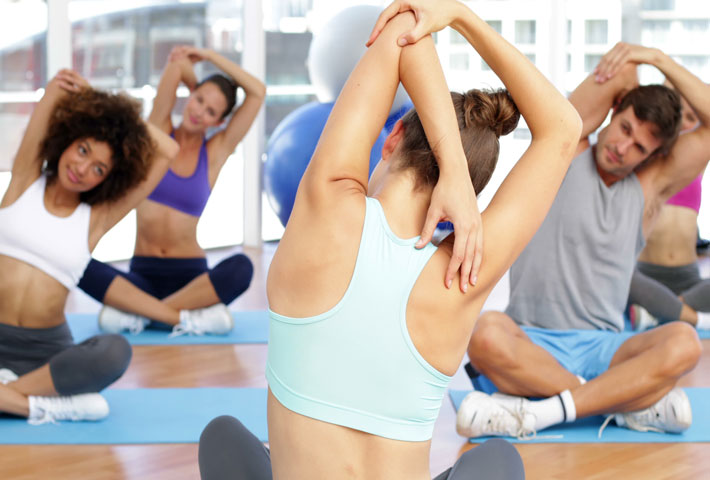
What is stretching, when and how must it be done but most of all what is its use.
Lets understand in detail what is this practice that we keep hearing repeated by even those who are not experts of the industry.
It was born in America in the 70s and spread quite quickly all over the world, stretching was born as a set of kinesiotherapy exercises for motor rehabilitation, that is useful during the periods of functional recovery for our organism. Till today every training program and sports discipline includes also stretching exercises, that have taken a fundamental role in the prevention and also the resolution of traumas.
The word stretching comes from the verb To Stretch, meaning, elongment and its main aim is extensibilty and flexibility or joint mobility, it acts directly and also indirectly on the muscle elasticity and contraction. Various types of stretching exist and they can be either static or dynamic and is generally recommended as the cooling down part of a workout. In our styleoga® yoga training method we put it both in the beginning and at the end of the session. When using it at the end of the workout it helps bring back in good conditions joint mobility and reduce the post-exercise metabolic waste. In the beginning of the session instead it is required because by lengthening our muscle fibres we manage to have a major contraction potential immediately after the warm up, infact it is never recommended to do it whilst muscles are still cold.
BENEFITS OF STRETCHING
If practiced regularly and constantly it gives us various benefits amongst which:
- increase muscle and tendon elasticity
- prevents joint trauma
- improves motion capability
- stimulates joint lubrification and the synovial fluid found in the joint capsule, attenuating degenerative diseases
- promotes blood circulation, improves breathing and reduces blood pressure
- reduces physical stress and helps movement coordination
IMPROVES POSTURE
One of the most important benefits of stretching is with no doubt linked to posture, causing also cellulitis, saggy breast or belly and infact staying seated for many hours tends to make us curve forward our shoulders, our neck lowers itself and our pectorals shorten and this how the saggy breast effect occurs, moreover our lower back muscles undergo a continuous contraction, that pushes out our belly, in these cases all the efforts and exercises are useless, infact only stretching can resolve these problems.
CONTRAINDICATIONS
Stretching is almost ideal for everyone, infact it has very few contraindications: It is not recommended only for those people who have recently undergone surgery or have suffered from muscle or joint problems or those who have been inactive for a very long period and must first undertake adeguate physiotherapy. The rest should follow the rule to listen to your body and don’t over do it.
EXERCISES
Here are some easy exercises that we can do alone:
STRETCHING INGUINAL AREA IN A SEATED POSITION
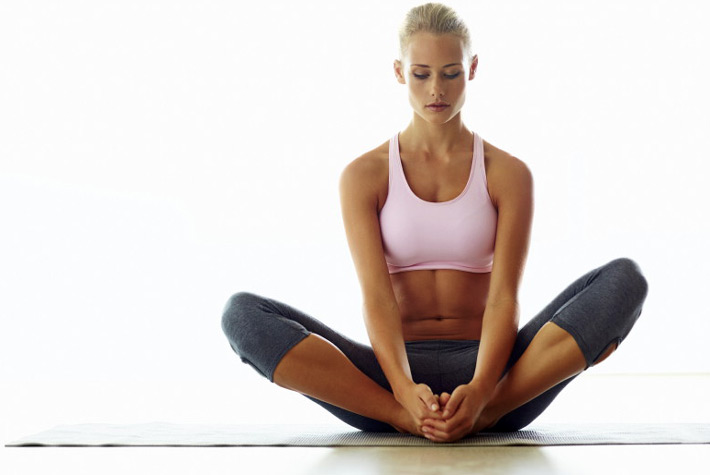
Put yourself into a seated position on the floor (mat) and put your soles together holding your toes tight together with your hands but without putting your heels to close towards the inner thighs. Bend forward until you feel your inguinal area stretch. Make sure to look forward and not down, do not push too forward neither your head nor your shoulders, Start by holding the position for just a few seconds and increase gradually unti you manage to hold for 30 seconds.
CALF STRETCHING
Stand in front of a wall, put your forehead forward towards the back of your hands leaning against the wall. Bend a leg a bring it forward, whilst the leg at the back must be stretched out and straight completely fixed on the ground. While in this position move your pelvis forward until you feel your calf stretch, we can than go from an easy stretch to an intensive one increasing gradually. This exercise must be than repeated on the the other leg.
If you want to deepen and start with the basics of yoga take a look at our ebook yoga for everyone


Leave A Comment